
If your Vernon home feels drafty in January and stuffy in July, the problem is usually insulation that has settled, thinned, or was never installed to begin with. Upgrading your attic, walls, crawl space, or rim joists with properly installed spray foam or traditional insulation seals the air leaks that drive heat loss, which typically lowers heating and cooling costs while keeping temperatures steady from room to room.
We work with homeowners throughout Vernon and the surrounding Oneida County area, and the patterns we see are consistent: older farmhouses with uninsulated knee walls, ranches with compressed fiberglass in the attic, and additions built over vented crawl spaces. Each of those creates a different comfort problem, and each calls for a different approach.
Benefits of Professional Insulation Upgrades

A properly insulated home in Vernon uses less fuel during Central New York winters and holds cooled air longer through humid July afternoons. The two changes homeowners notice first are smaller utility bills and rooms that stay at a consistent temperature.
Lower Energy Costs
Heating and cooling account for the largest share of most household energy use, and air leakage is usually the reason those systems run longer than they should.
When we seal a vented attic floor or rim joist with closed-cell spray foam, we stop the stack effect that pulls heated air upward and out of the house. The furnace cycles less often, and the equipment experiences less wear.
Typical upgrade areas we address include:
- Attic floors and roof decks — where the majority of winter heat loss occurs
- Rim joists and sill plates — common leak points in older Oneida County homes
- Crawl spaces and basement walls — sources of cold floors and damp air
- Knee walls and cathedral ceilings — often under-insulated in additions
Results vary by home age, existing R-value, and fuel type. During our assessment, we identify which areas offer the strongest return before recommending a scope of work.
Improved Indoor Comfort
Uneven temperatures between floors are one of the most common complaints we hear. A second story that runs 8 to 10 degrees warmer than the first usually points to insufficient attic insulation or unsealed bypasses around recessed lights and chases.
Air sealing paired with insulation narrows that gap. Rooms above garages, over porches, and at the ends of long duct runs benefit noticeably.
Comfort improvements extend beyond temperature:
| Issue | What the upgrade addresses |
|---|---|
| Drafts near baseboards and outlets | Sealed air pathways through wall cavities |
| Cold floors in winter | Insulated crawl spaces and basement rim joists |
| Ice dams on eaves | Reduced heat escaping into the attic |
| Outside noise | Added density in exterior walls |
Closed-cell foam also acts as a vapor retarder, which helps limit condensation in basements and crawl spaces where summer humidity is a concern.
Why Choose Us?
Choosing the right team for your home insulation can make a big difference in your comfort, energy bills, and peace of mind. At Highbridge Spray Foam, we make the process simple, effective, and stress-free.
Safe and Reliable Materials
We use high-quality insulation designed to last. It helps protect your home from drafts and moisture. You can feel confident your home is protected.
Clean and Careful Work
We treat your home with respect. Our team works neatly and cleans up after the job is done. We leave your space better than we found it.
Lower Energy Bills
Good insulation helps keep warm air in during winter and hot air out in summer. That means your heating and cooling system does not have to work as hard. You can enjoy a more efficient home.
Home Insulation in Vernon, NY: Improve Comfort and Energy Efficiency
Your home in Vernon, NY should provide consistent comfort in every season. Poor insulation can allow heated or cooled air to escape through walls, ceilings, and floors, leading to drafts, uneven temperatures, and higher energy bills. Professional insulation can help create a warmer, quieter, and more energy-efficient living environment.
What Is Home Insulation?
Home insulation helps control indoor temperatures by reducing heat transfer between your home and the outdoors. It helps keep warm air inside during winter and cool air inside during summer.
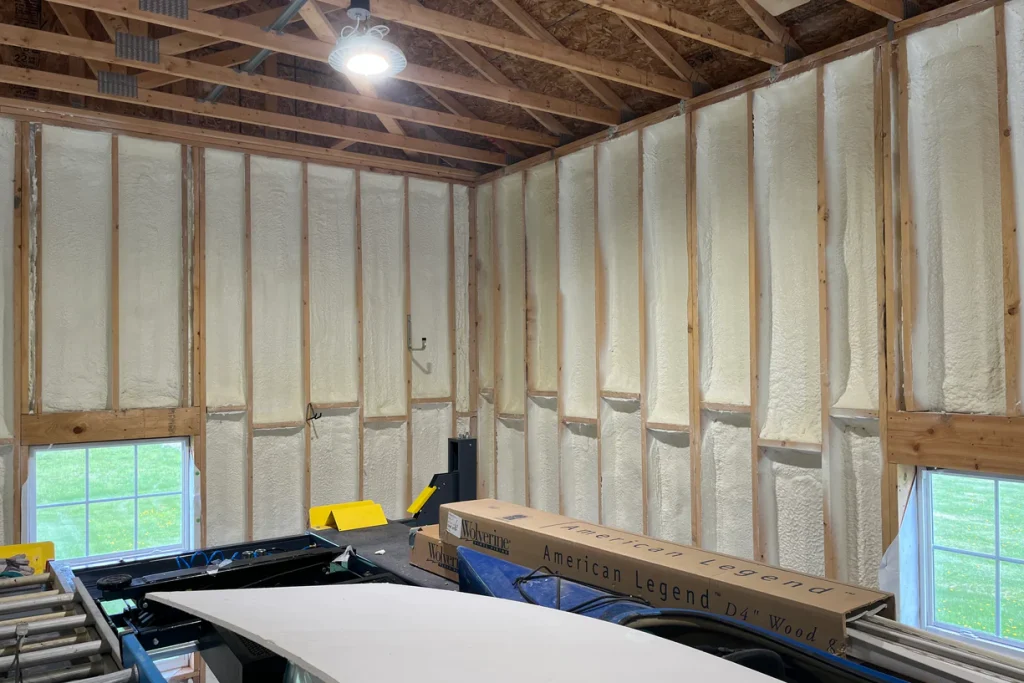
Proper insulation can also support moisture control and improve overall indoor comfort. With the right materials and professional installation, your insulation can provide reliable performance for years.
Insulation Options for Vernon Properties
Every building in Vernon has different insulation needs, whether it’s a 1940s farmhouse with an unfinished attic, a new build going up off Route 5, or a retail space losing heat through metal walls. We match the material and application method to the structure, the cavity, and the budget.
Spray Foam Applications
We install both open-cell and closed-cell polyurethane foam, and the choice depends on where it’s going.
Open-cell foam expands to roughly 100 times its liquid volume, delivers about R-3.7 per inch, and works well in interior walls and attic roof decks where sound dampening matters.
Closed-cell foam runs approximately R-6.5 per inch, resists water vapor, and adds rigidity to the assembly. We recommend it for rim joists, crawl spaces, basement walls, and any surface exposed to Central New York moisture.
Both seal air leaks as they cure, which addresses the drafts that fiberglass batts leave behind at seams and penetrations.
Typical installed pricing in this area falls between $1.20 and $2.50 per square foot, depending on foam type and thickness.
Attic and Wall Insulation
Attics account for a large share of heat loss in Vernon homes, and the 2020 New York Energy Conservation Code calls for R-49 in attic assemblies for our climate zone.
We use blown-in cellulose or fiberglass to reach that depth across attic floors, filling around joists and irregular framing without disturbing existing wiring or ductwork.
For walls, dense-pack blown-in insulation lets us insulate finished spaces through small access holes rather than removing drywall or siding.
| Application | Common Material | Target R-Value |
|---|---|---|
| Attic floor | Blown cellulose or fiberglass | R-49 |
| Attic roof deck | Open-cell spray foam | R-38 to R-49 |
| Exterior walls (retrofit) | Dense-pack blown-in | R-13 to R-21 |
| Rim joist | Closed-cell spray foam | R-15+ |
We also air seal top plates, chases, and can lights before adding material, since insulation alone doesn’t stop airflow.
Commercial Building Solutions
Warehouses, shops, offices, and agricultural buildings in Vernon and Vernon Center lose conditioned air through metal panel joints, roof decks, and loading dock walls.
We spray closed-cell foam directly to metal building interiors, where it adheres to the substrate, blocks condensation on cold panels, and adds structural stiffness.
For flat and low-slope commercial roofs, foam applied to the deck underside reduces thermal bridging through steel purlins.
We schedule work around operating hours where possible and coordinate with general contractors on new construction timelines, including inspections and code documentation.

We Proudly Serve Vernon
Upgrade Your home in Vernon, NY for Comfort & Savings!
Keep your home comfortable, quiet, and energy-efficient with Highbridge Spray Foam Home Insulation. Schedule your free inspection or request a quote today!
TESTIMONIALS


 Trustindex verifies that the original source of the review is Google.
 Trustindex verifies that the original source of the review is Google.
 Trustindex verifies that the original source of the review is Google.
 Trustindex verifies that the original source of the review is Google.
 Trustindex verifies that the original source of the review is Google.
 Trustindex verifies that the original source of the review is Google.
 Trustindex verifies that the original source of the review is Google.
 Trustindex verifies that the original source of the review is Google.
FREQUENTLY ASKED QUESTIONS
Homeowners and property owners in Vernon often ask about material choices, R-value performance, project timelines, and available funding before scheduling work. The answers below cover the practical details we discuss most often during estimates.
What types of insulation are best for homes and commercial buildings in Vernon, NY?
For most Vernon homes, closed-cell spray foam works well in rim joists, crawl spaces, basement walls, and unvented roof decks. It resists moisture and adds structural rigidity in areas exposed to Central New York winters.
Open-cell spray foam is a common choice for interior walls and attic roof lines where air sealing and sound reduction matter more than moisture resistance.
Blown-in cellulose or fiberglass remains practical for open attic floors, especially when you are topping up existing insulation to reach current levels.
Commercial buildings frequently need a combination approach. Metal buildings, pole barns, and warehouses often benefit from closed-cell foam on the underside of the roof deck to control condensation.
How does spray foam insulation compare with fiberglass and cellulose insulation?
The main difference is air sealing. Spray foam expands to fill gaps and cures into a barrier that stops air movement, while fiberglass batts and loose-fill cellulose slow heat transfer but allow air to pass through.
Here is a general comparison:
| Feature | Closed-Cell Foam | Open-Cell Foam | Fiberglass | Cellulose |
|---|---|---|---|---|
| R-value per inch | ~6.0–7.0 | ~3.5–3.8 | ~2.9–3.8 | ~3.2–3.8 |
| Air barrier | Yes | Yes | No | Partial |
| Moisture resistance | High | Low | Low | Low |
| Typical use | Basements, rim joists, roof decks | Interior walls, attics | Attic floors, wall cavities | Attic floors, dense-pack walls |
Fiberglass and cellulose cost less per square foot up front. Spray foam typically costs more but performs in a smaller cavity depth and does not settle or sag over time.
How much can new insulation reduce heating and cooling costs?
The U.S. Department of Energy estimates that air sealing and adding insulation in attics, floors over crawl spaces, and accessible basement rim joists can reduce annual heating and cooling costs by around 15%.
Actual results depend on the starting condition of the building. A home with an uninsulated attic and leaky rim joists will see a larger change than one with moderate existing coverage.
We measure existing R-values and identify air leakage points during the assessment so you have a realistic picture before committing to the work.
Which areas of a building should be insulated to improve energy efficiency?
The attic usually offers the largest return, since heat rises and escapes through ceiling gaps, recessed lights, and access hatches.
Rim joists and band joists in the basement are a frequent source of drafts. These narrow bands sit at the top of the foundation wall and are often left bare in older Vernon homes.
Other areas worth addressing:
- Crawl spaces — sealing walls rather than the floor above keeps ductwork and plumbing within the conditioned envelope
- Exterior walls — dense-pack or injection foam works without full demolition
- Cathedral ceilings — closed-cell foam manages both R-value and condensation risk
- Garages with living space above — insulating the ceiling reduces cold floors
How long does professional spray foam insulation installation take?
Most residential jobs finish in one day. A standard attic or crawl space application typically takes four to eight hours, including setup, spraying, and cleanup.
Whole-house projects or new construction with multiple assemblies may run two to three days.
Spray foam cures quickly, and reoccupancy is generally recommended after 24 hours for the treated area. We review the specific timeline and ventilation plan before we begin.
Are there rebates or incentives available for insulation upgrades in Vernon, NY?
Yes. NYSERDA offers programs through EmPower+ and Comfort Home that provide reduced-cost or no-cost insulation for income-qualified households, along with incentives for broader home energy improvements.
National Grid, which serves much of Oneida County, has historically offered rebates for insulation and air sealing work performed by participating contractors.
At the federal level, the Energy Efficient Home Improvement Credit (25C) allows a tax credit of 30% of insulation material costs, capped at $1,200 annually. Labor is not covered for insulation under this credit.
Program terms change, so we recommend confirming current eligibility with NYSERDA and your utility before scheduling. We can point you toward the relevant applications during your estimate.