
If your New Hartford home feels drafty in January and stuffy in July, the problem usually isn’t your furnace or air conditioner — it’s air leaking through gaps in your walls, attic, and rim joists. Highbridge Spray Foam installs spray foam, blown-in, and retrofit insulation throughout New Hartford, NY, sealing those gaps to lower energy bills and hold steady temperatures in every room.
We work with homeowners and property owners on existing homes, new construction, and commercial buildings across Central New York. Each project starts with a look at where your building is actually losing conditioned air, because the right material depends on the space we’re treating.
Spray foam creates an air barrier as it expands, which limits moisture movement and blocks entry points for pests. It also holds its shape rather than settling or sagging over time, so the R-value you pay for today is the one you keep.
Insulation Solutions for New Hartford Properties

New Hartford homes face cold Mohawk Valley winters and humid summers, and both put pressure on an underinsulated building envelope. We install spray foam and related insulation systems in the specific areas where heat loss and air leakage occur most: attics, walls, and crawl spaces.
Spray Foam Insulation Benefits
Spray polyurethane foam acts as insulation and an air barrier in a single application. That combination matters in Central New York, where air leakage often accounts for a large share of winter heat loss.
Closed-cell foam typically delivers about R-6 to R-7 per inch, resists moisture, and adds rigidity to framed assemblies. Open-cell foam runs closer to R-3.5 to R-4 per inch, costs less, and works well in interior applications where vapor movement is acceptable.
Practical results homeowners notice:
- Fewer drafts around rim joists, top plates, and outlets
- More consistent room-to-room temperatures
- Reduced load on furnaces and air conditioners
- Less dust and pollen entering through gaps
Foam also fills irregular cavities that batts leave open, which is common in older New Hartford housing stock.
Attic, Wall, and Crawl Space Applications
Each area of the house requires a different approach.
| Area | Typical Method | What It Addresses |
|---|---|---|
| Attic | Foam at the roof deck or air sealing plus loose-fill | Heat loss through the ceiling plane, ice dams |
| Walls | Injection foam or dense-pack in existing cavities; spray foam in open framing | Cold exterior walls, drafts, sound transfer |
| Crawl space | Closed-cell foam on walls and rim joists, vapor barrier on the floor | Cold floors, ground moisture, humidity |
In attics, we address bypasses around chimneys, ductwork, and recessed lights before adding insulation. Skipping that step limits performance.
For retrofits, we can insulate finished walls without full demolition by working through small access points.
Crawl spaces benefit from encapsulation. Sealing the space and insulating the perimeter usually performs better than insulating between floor joists in our climate.
Why Choose Us?
Hiring the right insulation contractor can make all the difference in your home’s comfort, energy efficiency, and safety. At Highbridge Spray Foam, we make insulation simple, effective, and worry-free.
Customized Solutions for
Your Home
Every home is different. We inspect your property and recommend the insulation solution that fits your needs perfectly.
Experienced &
Professional Team
Our certified crew has years of experience installing all types of insulation. We handle every project carefully, cleanly, and safely.
Energy Savings &
Comfort
Proper insulation keeps your home warmer in winter, cooler in summer, and reduces drafts. You’ll enjoy more even temperatures and lower energy bills.
Quality Insulation for Lasting Home Comfort
Your home in New Hartford, NY should provide consistent comfort and energy efficiency throughout the year. Insufficient insulation can contribute to heat loss, drafts, uneven temperatures, and increased energy costs. Professional insulation helps strengthen your home’s thermal barrier and improve overall indoor comfort.
What Is an Insulation Contractor?
An insulation contractor specializes in assessing, installing, and upgrading insulation systems throughout residential properties. Proper installation helps reduce heat transfer, limit air leakage, and maintain more consistent indoor temperatures. With the right materials and professional application, quality insulation can provide reliable, long-term performance and improved energy efficiency.
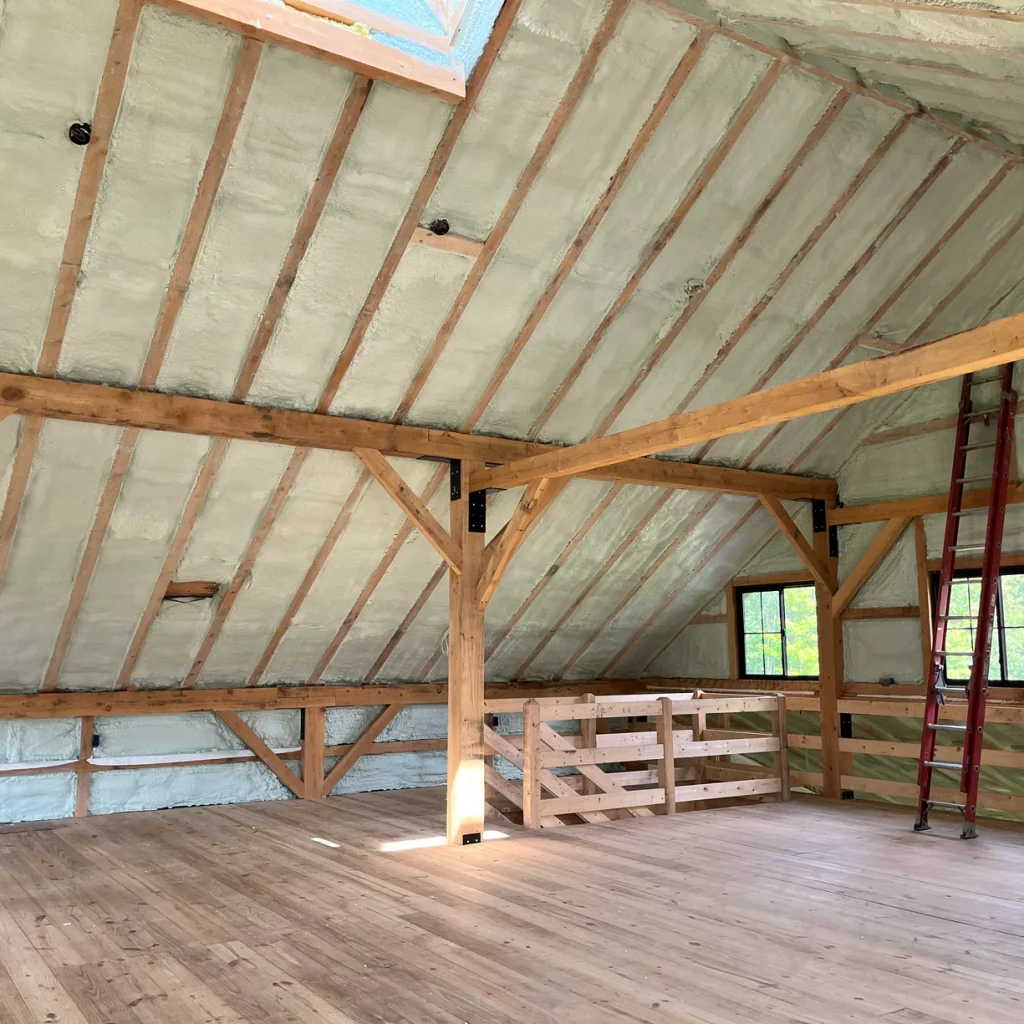
Quality Insulation Backed by Professional Expertise
We work on everything from single-family homes in New Hartford to warehouses and agricultural buildings across Central New York, and each job starts with an on-site evaluation rather than a phone quote. Our process is built around matching the right product and thickness to your building’s actual conditions.
Commercial and Residential Project Experience
Residential and commercial buildings fail in different ways, and we approach them differently.
In homes, the common problems are cold floors above unconditioned crawl spaces, ice damming along roof edges, and rooms over garages that never hold temperature. We handle attics, basement rim joists, knee walls, and new construction framing before drywall goes up.
On the commercial side, we work in pole barns, metal buildings, warehouses, and light manufacturing spaces where condensation on steel decking and high heating costs are the primary concerns.
Building types we insulate:
- New construction homes and additions
- Attics, crawl spaces, and basements
- Pole barns and metal buildings
- Warehouses and shop spaces
- Agricultural and storage structures
Professional Assessment and Installation Process
We start by walking the property and identifying where air is moving and where insulation is missing or compressed. That determines whether open-cell or closed-cell foam makes sense, and at what depth.
| Step | What Happens |
|---|---|
| Assessment | On-site inspection of the areas to be insulated |
| Recommendation | Foam type, R-value, and coverage area specified |
| Written estimate | Scope and pricing provided before work begins |
| Installation | Surfaces prepped, foam applied, site cleaned |
Closed-cell foam is typically our choice for crawl spaces, rim joists, and metal buildings because it resists moisture and adds structural rigidity. Open-cell works well in attics and interior walls where sound control and cost matter more.
We schedule new construction work around your framing and mechanical rough-in so the project stays on track.

We Proudly Serve New Hartford
Upgrade Your Home’s Comfort with a Trusted Insulation Contractor!
Save energy, reduce drafts, and protect your home with Highbridge Spray Foam, your local insulation contractor in New Hartford, NY. Schedule your free inspection or request a quote today!
TESTIMONIALS


 Trustindex verifies that the original source of the review is Google.
 Trustindex verifies that the original source of the review is Google.
 Trustindex verifies that the original source of the review is Google.
 Trustindex verifies that the original source of the review is Google.
 Trustindex verifies that the original source of the review is Google.
 Trustindex verifies that the original source of the review is Google.
 Trustindex verifies that the original source of the review is Google.
 Trustindex verifies that the original source of the review is Google.
FREQUENTLY ASKED QUESTIONS
Pricing, safety, insurance considerations, removal options, material comparisons, and project timelines are the topics homeowners and business owners in New Hartford ask us about most. The answers below reflect how we handle spray foam and blown-in insulation work across Oneida County and Central New York.
How much does spray foam insulation cost for a home or commercial building in New Hartford, NY?
Cost depends on the square footage, the type of foam, and the thickness required. Open-cell foam generally runs about $0.45 to $1.50 per board foot, while closed-cell foam typically falls between $1.00 and $2.50 per board foot in this region.
A standard attic in a single-family home often lands in the $2,000 to $5,000 range. Larger commercial projects, metal buildings, and pole barns are quoted separately based on wall height, access, and whether the structure is heated.
We provide written estimates after an on-site assessment. Measuring the actual cavity depths and identifying air leakage points gives a far more accurate number than a phone quote.
Is spray foam insulation safe for homes and businesses?
Yes, once it has fully cured. Spray foam is a two-component product that reacts and hardens on the substrate, and cured foam is chemically inert.
The precautions apply during installation. Our crews wear supplied-air respirators and protective equipment, and we ask that the building be vacated during application and for the ventilation period afterward.
Typical re-entry time is 24 hours for most residential jobs, though this varies by product and ventilation conditions. We confirm the manufacturer’s specified re-occupancy window before we start and let you know exactly when the space is ready.
Why do some insurance companies have concerns about spray foam insulation?
Concerns usually center on two issues: improper installation and coverage of roof structures.
When foam is applied at the wrong ratio or temperature, it may not cure correctly, which can lead to odor problems or shrinkage. Some underwriters, particularly in the UK mortgage market, have also raised questions about foam applied directly to roof decking because it makes visual inspection of rafters difficult.
In the United States, spray foam applied to code by a qualified installer is widely accepted. We document product data sheets, thickness, and R-values on every job so you have records to share with your insurer or a home inspector.
If you have a specific carrier requirement, tell us before we begin and we will confirm the assembly meets it.
Can spray foam insulation be removed if needed?
It can, though the process is labor-intensive. Cured foam bonds tightly to the substrate and must be cut, scraped, or ground off rather than pulled out like batts.
Open-cell foam is softer and comes away more readily than closed-cell. Removal from irregular surfaces such as rafters or joists takes longer than removal from flat sheathing.
Because removal costs can exceed the original installation, we spend time up front confirming that spray foam is the right product for your assembly. In some cases blown-in cellulose or fiberglass is the better fit, and we will say so.
What are the benefits of spray foam compared with fiberglass or cellulose insulation?
The main difference is air sealing. Fiberglass and cellulose slow heat transfer but allow air to move through and around them, while spray foam expands to fill gaps and forms a continuous barrier.
Key distinctions:
- R-value per inch — Closed-cell foam delivers roughly R-6 to R-7 per inch, open-cell about R-3.5 to R-3.8, fiberglass batts around R-3.1 to R-3.4, and dense-packed cellulose about R-3.5.
- Moisture — Closed-cell foam at sufficient thickness acts as a vapor retarder. Fiberglass and cellulose absorb and hold moisture.
- Settling — Foam does not settle or sag over time. Loose-fill materials can compress.
- Structural rigidity — Closed-cell foam adds some racking strength to wall assemblies.
Fiberglass and cellulose still make sense in plenty of situations, particularly for topping up existing attic insulation or retrofitting closed wall cavities without demolition. We offer blown-in insulation for exactly those applications.
How long does professional spray foam insulation installation take?
Most residential attics or crawl spaces are completed in one day. A full home retrofit involving walls, attic, and rim joists usually takes two to three days.
New construction projects are scheduled around the framing and rough-in inspections, and the spraying itself often takes a single day for an average-sized house. Metal buildings and commercial spaces depend on square footage and wall height.
Preparation and cleanup add time to the schedule. We mask off surfaces, protect finishes, and handle site cleanup as part of the job, and we give you a firm timeline with the estimate.