
Metal buildings heat up fast in summer, lose heat quickly in winter, and collect condensation on interior steel surfaces year-round. Closed-cell spray foam insulation applied directly to metal panels seals air leaks, blocks moisture, and adds thermal resistance in a single application, which is why it remains the most effective option for pole barns, garages, and steel-frame commercial buildings in Vernon, NY.
Traditional fiberglass batts and vinyl-backed blankets sag, trap moisture against the steel, and leave gaps where air moves freely. Spray foam adheres to the panel itself, so there are no seams for warm interior air to reach cold metal and form condensation.
We install metal building insulation throughout Vernon and the surrounding Central New York area, working with homeowners protecting workshops and storage buildings as well as company owners managing heated warehouses and shop space.
Why Metal Buildings Need Proper Insulation
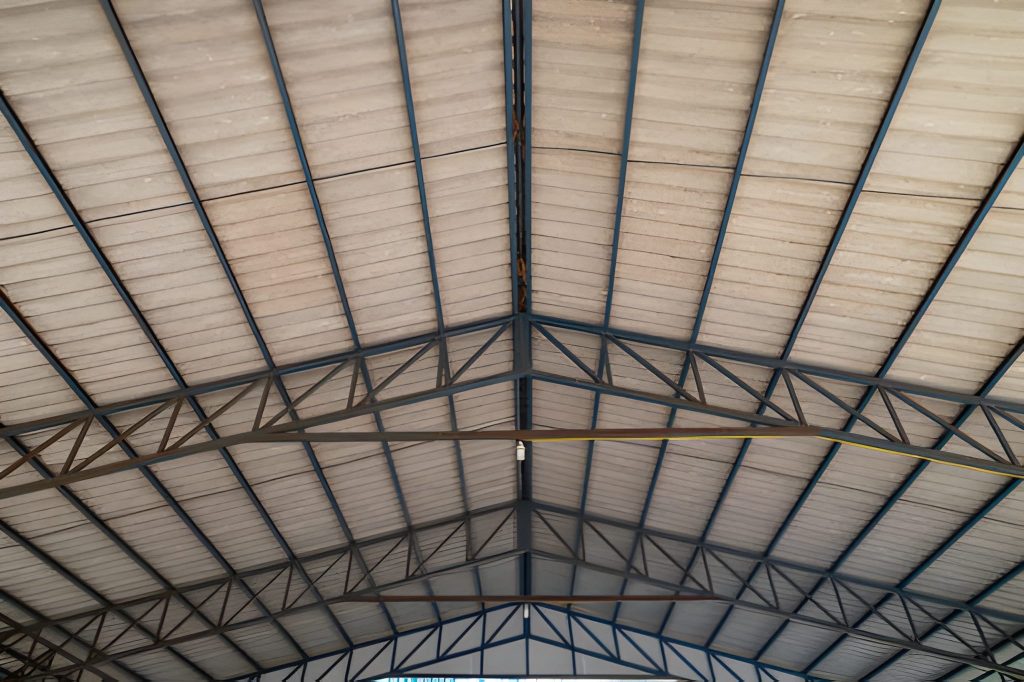
Steel conducts heat roughly 300 times faster than wood, which means an uninsulated metal building swings hard with the outside temperature and pulls moisture out of the air onto every cold surface. Two problems drive most of the calls we get in Oneida County: water dripping from the underside of a roof deck, and heating bills that don’t match the size of the space.
Condensation Control and Moisture Protection
Condensation forms when warm, humid interior air contacts steel panels that sit below the dew point. In a Vernon shop or barn, that happens on almost any cold morning between October and April.
The result is water on the purlins, rust at fastener penetrations, damp stored equipment, and mold growth on anything organic inside.
Closed-cell spray polyurethane foam addresses this differently than batts or blankets. At about 2 inches, it functions as a Class II vapor retarder and bonds directly to the steel, so there is no air gap where moisture can reach a cold surface.
Fiberglass, by contrast, allows air movement around and behind the material. Once it absorbs moisture, it compresses, loses R-value, and holds water against the panel.
Energy Efficiency in Vernon, NY Weather
Vernon sits in Climate Zone 6A, with winter design temperatures near -5°F and roughly 7,000 heating degree days annually. Metal framing creates thermal bridges at every purlin and girt, and those steel members can account for a meaningful share of total heat loss when insulation stops at the cavity.
Continuous closed-cell foam applied over the framing interrupts that bridge.
| Insulation | R-value per inch | Air seal | Vapor control |
|---|---|---|---|
| Closed-cell spray foam | 6.5 – 7.0 | Yes | Yes at 2″+ |
| Open-cell spray foam | 3.6 – 3.9 | Yes | No |
| Fiberglass blanket | 3.1 – 3.4 | No | Facing only |
Air leakage typically accounts for 25–40% of heating loss in a building. Sealing seams, base plates, and roof-to-wall joints with foam reduces that load before the furnace or heat pump ever runs.
Why Choose Us?
Choosing the right team for your metal building insulation can make a big difference in your comfort, energy bills, and peace of mind. At Highbridge Spray Foam, we make the process simple, effective, and stress-free.
Safe and Reliable Materials
We use durable and safe insulation built for metal buildings, keeping them protected from moisture, drafts, and temperature swings.
Experienced and Reliable Team
We handle every project with care, professionalism, and attention to detail. You can count on us to do it right.
Save on Energy Costs
Well-insulated metal buildings use less energy. That means lower bills and smarter spending.
Metal Building Insulation in Vernon, NY
Metal buildings in Vernon, NY need proper insulation to stay comfortable, efficient, and protected year-round. Without adequate insulation, these structures can experience extreme temperature changes, condensation, higher energy costs, and uncomfortable interior conditions.
How Metal Building Insulation Works
Metal building insulation helps regulate indoor temperatures by reducing heat transfer through walls and roofs. It also helps control condensation, minimize drafts, and improve energy efficiency. Proper insulation can create a more stable and comfortable environment for workshops, garages, warehouses, agricultural buildings, and other metal structures.
Why Metal Building Insulation Matters
Professional insulation helps protect your building from temperature extremes and moisture-related concerns while reducing heating and cooling demands. With the right insulation system, you can improve comfort, efficiency, and the long-term performance of your metal building.
Insulation Solutions for Your Property
Metal buildings in Vernon lose heat through thin steel panels, uninsulated purlins, and gaps at seams and fasteners. Closed-cell spray foam addresses all three at once, though the right thickness and product depend on how you use the building.
Spray Foam for Metal Building Envelopes
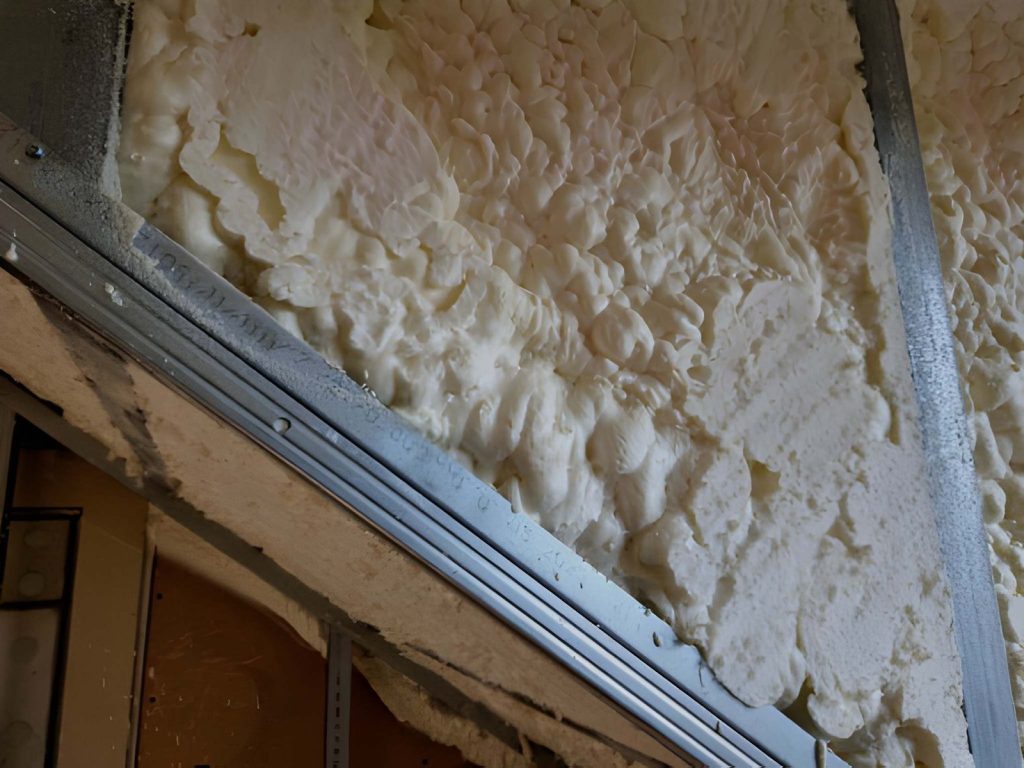
Closed-cell spray foam bonds directly to steel panels, filling the ribs and voids that batts and blankets leave open. It expands into seams, around fasteners, and along the roof deck, forming a continuous air barrier.
Typical applications in metal structures use 3 inches on the roof deck and 2 inches on walls, which delivers roughly R-19 to R-21 at the roof and R-13 to R-14 at the walls.
The moisture control matters as much as the R-value. Warm interior air hitting cold steel produces condensation, which drips onto stored equipment and accelerates corrosion. Closed-cell foam at 2 inches or more acts as a vapor retarder, keeping that moisture away from the panel surface.
It also adds rigidity to the panel assembly, reducing rattle and flex during winter wind.
Choosing the Right Insulation Approach
The right specification depends on how the building is used and heated.
| Building Use | Recommended Approach |
|---|---|
| Heated shop or garage | Closed-cell foam, roof and walls |
| Unheated storage | Roof deck only, condensation control |
| Pole barn conversion | Full envelope, higher thickness |
| Existing insulated walls | Blown-in top-up, foam at roof |
We walk the building before quoting. Panel gauge, existing vapor barriers, interior finishes, and whether you plan to add heat all change the answer.
Open-cell foam costs less per board foot but is not appropriate against steel in our climate zone, since it allows vapor to reach the cold surface.
For structures with usable wall cavities, blown-in insulation can supplement foam at the roof and reduce total project cost.
We Proudly Serve Vernon
Improve Your Metal Building Today
Protect your metal building from temperature extremes, condensation, and energy loss with professional insulation from Highbridge Spray Foam. Schedule your free inspection or request a quote today and take the first step toward a more efficient, comfortable building in Vernon, NY.
TESTIMONIALS
 Posted on Google

 Paul Hesler
Trustindex verifies that the original source of the review is Google.
Bret and his crew at Highbridge Spray Foam did an outstanding job! And they were incredibly dependable and courteous! Were great counsel when making suggestions! Would absolutely recommend them!!Posted on Google Barbara SoperCannot say enough about this wonderful company! They quickly returned my call. Arrived at the worksite within 48 hours of my initial contact! Gave us an estimate with 3 options clearly outlined what they would suggest. Made contact with town building codes quickly and professionally. Codes required higher R value on rooftop. Scheduled installation and they arrived as promised! Project was handled from the beginning to the end with complete professionalism! High recommend!!Posted on Google
 Judith WenhamThey do the best work with the best product!!!!Posted on Google
 Samuel MohranI can’t thank Brett and his team enough for the great job they did insulating the basement on my new construction home! This small business is very professional, courteous, and their attention to detail is at the top of their trade. And not only is his work excellent, the cost is better than any other company! There has been an immediate improvement in temperature and humidity, not only in the basement, but throughout the whole house as well! I can’t express my satisfaction enough with Brett and any future project I have, Highbridge will be the first call I make.Posted on Google
 Lisa EusticeExcellent crew and service! I am very pleased with their work and will be calling them again for my next project.Posted on Google
 Bruce BereanBrett from Highbridge came and gave me a quote to foam my breezeway floor. It is a narrow space between the floor and the ground. We agreed on a time to complete the work. He and his partner were right on time and got right to work. Brett crawled under the floor and removed all of the old insulation and began foaming the area we agreed on. He never complained that it was too tight to work in or that it was dirty. I would absolutely recommend Brett and Highbridge Spray Foam to do all of your insulation needs.Posted on Google
 Cheyenne FelkerI had spray foam applied in a new addition today. I can already tell the difference in temperature and even sound in that area. Super happy with the communication, turnaround time, speed of application, and clean up. Thanks Highbridge Spray Foam!Posted on Google
 todd babiczbrett and his crew are by far the best of the best! highbridge pays very close attention to every detail you mention and they deliver on it with precise workmanship. from the moment they arrive till the second they leave you feel like you are in good competent hands. i couldn’t be happier with the job they did. i will never go to anyone else. keep on keeping on highbridge! i will most definitely be a repeat customer!Verified by TrustindexTrustindex verified that these reviews were published on Highbridge Spray Foam's Google Business Profile. Learn more
FREQUENTLY ASKED QUESTIONS
Metal buildings in Vernon face specific challenges: thermal bridging through steel framing, condensation on cold interior surfaces, and air leakage at panel seams. The answers below cover material selection, pricing, application methods, and service life for closed-cell spray foam in steel structures.
What type of insulation is best for a metal building?
Closed-cell spray polyurethane foam is the most effective option for most metal buildings in Central New York. It delivers roughly R-6 to R-7 per inch, blocks air movement, and acts as a vapor retarder at about 2 inches of thickness.
Fiberglass batts and banded liner systems cost less upfront but compress against purlins and girts, which reduces their real-world performance. Rigid polyiso board works well on the exterior side but requires careful detailing at every seam and fastener.
For pole barns, shops, and warehouses where humidity control matters, we typically recommend closed-cell foam on the roof deck and walls.
How much does it cost to insulate a metal building with spray foam?
Closed-cell spray foam generally runs $2.50 to $5.00 per square foot installed, depending on thickness. Open-cell foam costs less per square foot but is not the right choice for uninsulated steel panels because it allows moisture to reach the metal.
A 40×60 pole barn with walls and roof insulated to code-level thickness usually falls somewhere between $10,000 and $20,000. Final pricing depends on ceiling height, framing spacing, existing conditions, and whether prep work or removal of old insulation is required.
We provide written estimates after measuring the building, so you know the cost before any work begins.
Can spray foam insulation be applied directly to metal walls and ceilings?
Yes. Closed-cell foam adheres directly to clean, dry steel panels and forms a continuous layer that follows the profile of the ribs and framing.
The surface has to be free of oil, dust, and rust before application. We clean and prep panels first, since adhesion depends entirely on surface condition.
One caution: foam applied directly to metal makes future panel replacement more difficult, because the foam bonds to the back of the sheet.
Does spray foam insulation help prevent condensation in metal buildings?
It addresses the main cause. Condensation forms when warm, humid interior air contacts cold steel — closed-cell foam keeps that air from reaching the panel surface.
At 2 inches or more, closed-cell foam functions as a Class II vapor retarder, so moisture vapor does not diffuse through to the metal. This is why we see fewer dripping ceilings and less rust in buildings that have been foamed compared to those with batt insulation.
Ventilation and heating still matter. Foam eliminates the condensation path, but a building with an unvented propane heater and no air exchange will still have high humidity.
Is it safe to install spray foam insulation in an existing metal building?
Yes, when the work is done by trained installers with proper equipment. During application and curing, the space must be unoccupied and mechanically ventilated.
Our crews wear supplied-air respirators and full protective gear. We ask that the building stay vacant for 24 hours after installation, after which the foam is fully cured and chemically inert.
Retrofits are common in Vernon-area barns and shops. We work around existing electrical, plumbing, and stored equipment, and mask off anything that needs protection from overspray.
How long does spray foam insulation last in a metal building?
Closed-cell spray foam does not settle, sag, or degrade with age. In a properly installed application, it lasts the service life of the building — typically 30 years or more.
It does not absorb water, and it provides no food value for mold or pests. Unlike fiberglass, it will not need replacement after a roof leak, though the leak itself should still be repaired.
The main threat to performance is UV exposure, which is why any foam applied to an exterior surface needs a protective coating.