
Insulating during new construction is the most cost-effective time to build an energy-efficient home or commercial building in Syracuse, because walls, roofs, and rim joists are still open and accessible. Once drywall goes up, adding a continuous air barrier becomes far more disruptive and expensive.
Central New York puts real demands on a building envelope. Winter temperatures regularly drop below freezing for months, summer humidity moves moisture through assemblies, and the gap between the two seasons can span 100 degrees.
At Highbridge Spray Foam, we work with homeowners, builders, and property owners across Syracuse and the surrounding area to specify and install insulation during the framing stage.
Insulation Options for New Builds

Framing stage is the only time your walls, rim joists, and roof deck are fully accessible, which makes material selection a decision worth getting right the first time. In Syracuse, where design temperatures drop below zero and heating seasons run long, the choice comes down to spray foam, fiberglass, cellulose, or a combination of the three.
Spray Foam Insulation Benefits
Spray foam is applied as a liquid and expands to fill stud bays, rim joists, and irregular cavities around wiring and plumbing. That expansion seals air leaks and insulates in a single step.
We install two types on new construction projects:
| Type | Approximate R-Value per Inch | Common Applications |
|---|---|---|
| Open-cell | R-3.5 to R-3.8 | Interior walls, sound control, vented attic slopes |
| Closed-cell | R-6 to R-7 | Rim joists, crawl spaces, cathedral ceilings, exterior walls |
Closed-cell foam also acts as a vapor retarder and adds rigidity to the assembly — useful in unconditioned crawl spaces and basements where moisture is a concern.
Because foam adheres directly to the substrate, it does not sag, settle, or leave gaps as the building dries and shifts over the first few years.
Fiberglass and Cellulose Alternatives
Fiberglass and cellulose remain practical choices when budget or code compliance is the priority rather than maximum air sealing.
Blown fiberglass fills attic floors quickly and holds its R-value well in open, ventilated spaces. Batts work in standard 16-inch and 24-inch stud bays, though they require careful cutting around blocking and outlets to perform as rated.
Dense-packed cellulose is made largely from recycled paper treated with borate. It resists airflow better than batts and fills wall cavities completely, making it a reasonable option for exterior walls on a fixed budget.
We frequently pair these materials with foam — for example, closed-cell at the rim joists and blown fiberglass across the attic floor. This hybrid approach targets the highest-leakage areas without applying foam to the entire building envelope.
Why Choose Us?
Choosing the right insulation team for your new build sets the foundation for a comfortable, energy-efficient, and problem-free home. At Highbridge Spray Foam, we install it right the first time—clean, fast, and built to last.
High-Performance Spray Foam
Our insulation seals gaps and cracks to help stop air leaks. This keeps your home more comfortable in every season.
Clean and Professional Work
We respect your job site and your timeline. Our team works efficiently and keeps the space clean.
Built for Long-Term Value
Good insulation protects your investment. It helps prevent future problems before they start.
Make Your New Home Comfortable from Day One
Every new build in Syracuse, NY deserves to be energy-efficient and cozy. Poorly installed or missing insulation can cause temperature swings, drafts, and energy waste. This can lead to uneven temperatures, drafts, and higher energy bills. Proper insulation from the start ensures your home is cozy, quiet, and energy-efficient.
What Is New Construction Insulation?
New construction insulation stops warm or cool air from escaping through walls, ceilings, and floors. It keeps your home cozy in winter and cool in summer. Proper insulation prevents moisture buildup, mold growth, and unwanted pests. Modern insulation stays effective for years and seals gaps completely.
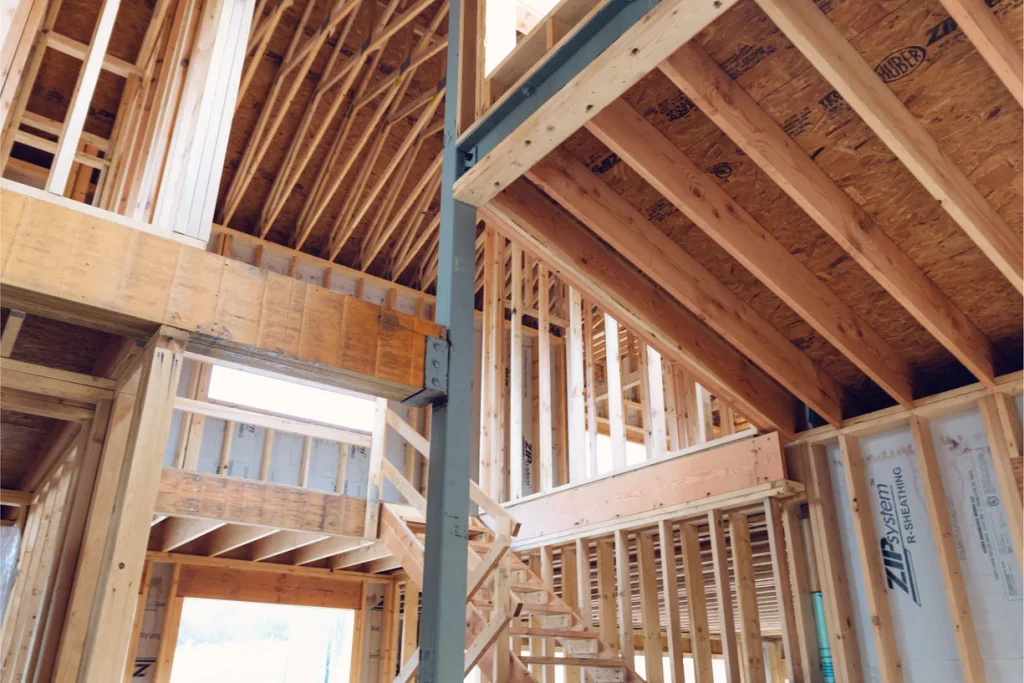
Benefits of New Construction Insulation
Proper insulation saves money on energy bills, reduces drafts, and keeps your home comfortable. Insulation shields your new home from structural damage caused by moisture and keeps pests out.
Planning for Energy Efficiency and Building Performance
Insulation decisions made during framing determine how a Syracuse home performs for decades, from winter heating bills to summer humidity levels. We approach each project by addressing three connected elements: the continuous air barrier, assembly-specific insulation choices, and compliance with New York’s energy code.
Air Sealing and Moisture Control
Air leakage moves both heat and moisture. In Central New York’s climate, warm indoor air escaping into an unconditioned attic during January carries water vapor that condenses on cold sheathing.
Closed-cell spray foam addresses this directly. At around 2 inches, it functions as an air barrier, a vapor retarder, and insulation in a single application.
We focus air sealing on the locations that leak most:
- Rim joists and sill plates
- Top plates and attic penetrations
- Around window and door rough openings
- Plumbing, electrical, and HVAC chases
- Attic hatches and knee walls
Tighter construction also means mechanical ventilation matters more. We coordinate with builders and HVAC contractors so that balanced ventilation is planned alongside the envelope, not added afterward.
Insulation for Walls, Attics, and Foundations
Different assemblies call for different products and thicknesses.
| Assembly | Typical Approach |
|---|---|
| Exterior walls | Closed-cell spray foam at 2–3″, or open-cell foam with a code-compliant vapor strategy |
| Attic flat | Air seal the ceiling plane, then blown-in cellulose or fiberglass to the required R-value |
| Cathedral/vaulted ceilings | Closed-cell foam applied directly to the roof deck, creating an unvented assembly |
| Rim joists | Closed-cell spray foam, one of the highest-return areas per square foot |
| Basement walls and crawl spaces | Closed-cell foam on foundation walls to control ground moisture and cold surfaces |
Closed-cell foam adds structural rigidity to wall assemblies and does not absorb water. Open-cell foam costs less per board foot and provides sound dampening, which makes it a reasonable choice for interior partitions and some attic applications.
We size systems based on the assembly depth, the drying direction, and the builder’s target for blower door performance.
Local Code and Project Considerations
Syracuse falls in Climate Zone 5A under the New York State Energy Conservation Construction Code. New residential construction generally requires R-49 ceiling insulation, R-20 cavity or R-13 plus R-5 continuous for above-grade walls, and R-15 continuous or R-19 cavity for basement walls, though prescriptive tables and performance paths offer alternatives.
Blower door testing is required, with an air leakage limit that spray foam assemblies typically meet without difficulty.
Timing matters on the job site. We schedule installation after rough-in inspections for electrical, plumbing, and HVAC are complete, and we coordinate with drywall crews so foam has time to cure and be trimmed.
Foam applied to interior surfaces requires an approved thermal barrier, usually half-inch gypsum board, or an approved ignition barrier in limited-access attics and crawl spaces. We build that requirement into the scope before work begins.

We Proudly Serve Syracuse
Upgrade Your new home in Syracuse, NY for Comfort & Savings!
Keep your new home comfortable, efficient, and protected from day one with Highbridge Spray Foam New Construction Insulation. Schedule your free inspection or request a quote today!
TESTIMONIALS
 Posted on Google

 Paul Hesler
Trustindex verifies that the original source of the review is Google.
Bret and his crew at Highbridge Spray Foam did an outstanding job! And they were incredibly dependable and courteous! Were great counsel when making suggestions! Would absolutely recommend them!!Posted on Google Barbara SoperCannot say enough about this wonderful company! They quickly returned my call. Arrived at the worksite within 48 hours of my initial contact! Gave us an estimate with 3 options clearly outlined what they would suggest. Made contact with town building codes quickly and professionally. Codes required higher R value on rooftop. Scheduled installation and they arrived as promised! Project was handled from the beginning to the end with complete professionalism! High recommend!!Posted on Google
 Judith WenhamThey do the best work with the best product!!!!Posted on Google
 Samuel MohranI can’t thank Brett and his team enough for the great job they did insulating the basement on my new construction home! This small business is very professional, courteous, and their attention to detail is at the top of their trade. And not only is his work excellent, the cost is better than any other company! There has been an immediate improvement in temperature and humidity, not only in the basement, but throughout the whole house as well! I can’t express my satisfaction enough with Brett and any future project I have, Highbridge will be the first call I make.Posted on Google
 Lisa EusticeExcellent crew and service! I am very pleased with their work and will be calling them again for my next project.Posted on Google
 Bruce BereanBrett from Highbridge came and gave me a quote to foam my breezeway floor. It is a narrow space between the floor and the ground. We agreed on a time to complete the work. He and his partner were right on time and got right to work. Brett crawled under the floor and removed all of the old insulation and began foaming the area we agreed on. He never complained that it was too tight to work in or that it was dirty. I would absolutely recommend Brett and Highbridge Spray Foam to do all of your insulation needs.Posted on Google
 Cheyenne FelkerI had spray foam applied in a new addition today. I can already tell the difference in temperature and even sound in that area. Super happy with the communication, turnaround time, speed of application, and clean up. Thanks Highbridge Spray Foam!Posted on Google
 todd babiczbrett and his crew are by far the best of the best! highbridge pays very close attention to every detail you mention and they deliver on it with precise workmanship. from the moment they arrive till the second they leave you feel like you are in good competent hands. i couldn’t be happier with the job they did. i will never go to anyone else. keep on keeping on highbridge! i will most definitely be a repeat customer!Verified by TrustindexTrustindex verified that these reviews were published on Highbridge Spray Foam's Google Business Profile. Learn more
FREQUENTLY ASKED QUESTIONS
Below we answer the questions we hear most often from builders and homeowners planning insulation for new homes and commercial buildings in Syracuse — covering material choices, timing within the framing schedule, cost factors, code compliance, and the performance results you can expect.
What are the benefits of spray foam insulation for a newly constructed home or commercial building?
Spray foam expands after application, filling gaps around framing members, electrical boxes, and plumbing penetrations that batt insulation often leaves open. That combination of insulation and air sealing in a single product reduces air leakage, which is one of the largest sources of energy loss in new buildings.
For Syracuse projects, this matters during lake-effect snow events and long stretches of subfreezing temperatures. Sealed assemblies hold conditioned air inside and keep cold drafts from moving through rim joists and attic planes.
Other practical advantages include:
- Moisture control — closed-cell foam resists liquid water and slows vapor movement
- Structural rigidity — closed-cell foam adds a small amount of racking strength to wall assemblies
- No settling — foam adheres to substrates and holds its shape over decades
- Smaller HVAC equipment — tighter envelopes often allow reduced heating and cooling loads
- Sound dampening — open-cell foam absorbs airborne noise between rooms and floors
How much does spray foam insulation cost for a new construction project in Syracuse, NY?
Pricing depends on the type of foam, the thickness required to hit target R-values, and the square footage being covered. Open-cell foam generally costs less per board foot than closed-cell, but closed-cell delivers roughly double the R-value per inch, so the comparison depends on the assembly.
Access also affects labor time. Open framing on a new build is faster to spray than a retrofit, which usually keeps new construction pricing more predictable than remodel work.
We provide free written estimates that break out material type, applied thickness, and the specific areas covered — walls, roof deck, rim joists, crawl spaces, or attic floor. That lets you compare our proposal against other bids on equal terms rather than a single lump-sum number.
Which type of spray foam insulation is best for new construction: open-cell or closed-cell?
Neither option is universally better; the right choice depends on where the foam is going.
Closed-cell foam delivers approximately R-6 to R-7 per inch, resists bulk water, and functions as a vapor retarder at sufficient thickness. We typically specify it for rim joists, crawl space walls, basement walls, unvented roof decks, and any assembly in contact with concrete or exposed to exterior moisture.
Open-cell foam delivers approximately R-3.5 to R-4 per inch at a lower material cost. It works well in interior wall cavities and attic applications where cavity depth is generous and moisture exposure is limited.
Many of the projects we complete in Central New York use both — closed-cell in below-grade and roof assemblies, open-cell in above-grade wall cavities and interior partitions.
When should spray foam insulation be installed during the new construction process?
Foam goes in after the building is dried in and rough-in trades are complete. That means the roof, windows, and exterior sheathing are in place, and electrical, plumbing, and HVAC rough-ins have passed inspection.
Spraying before rough-in inspection creates problems, since inspectors need visual access to wiring and piping. Spraying after drywall obviously eliminates access to the cavities entirely.
We coordinate directly with general contractors to schedule our crew in that window. Cavity depth, framing details, and target R-values are easiest to address if we review the plans before framing begins.
How can spray foam insulation improve energy efficiency and indoor comfort in a new building?
Air leakage moves heat and moisture through a building envelope regardless of how much R-value sits in the cavity. Sealing those pathways with foam reduces the volume of unconditioned air the HVAC system has to condition each hour.
The comfort results show up in specific ways. Temperature differences between floors narrow, rooms above garages and over unheated spaces stay closer to setpoint, and drafts near baseboards and outlets diminish.
Humidity management improves as well. Less infiltration during humid Syracuse summers means less moisture entering the building, which reduces the load on air conditioning and dehumidification equipment.
Does spray foam insulation meet New York building code requirements for new construction?
Yes. Spray foam is an approved insulation material under the New York State Energy Conservation Construction Code, and Syracuse falls in Climate Zone 5A, which sets minimum R-values for walls, ceilings, floors, and foundations.
Two code items require attention with foam. First, most spray foams are combustible and need an approved thermal barrier — typically half-inch drywall — or an ignition barrier in limited-access areas like crawl spaces and attics.
Second, unvented roof assemblies have specific requirements for condensation control, including minimum insulation values on the exterior side of the assembly in colder climate zones.
We install to code-required thicknesses and document applied depths and material specifications for your inspector. If your project targets a program like ENERGY STAR or a stretch code, we can adjust the specification to meet those tighter thresholds.